
The Science Behind 12-Hour Shift Comfort

Comfort isn’t just a feeling for healthcare pros—it’s a requirement. Nurses don’t work in short bursts. A 12-hour shift is sustained physical work with hours of walking, standing, pivoting, and reacting on hard hospital floors.
That’s why the real question isn’t “Do these shoes feel good at hour one?” It’s “Do they still support me at hour ten?” Because when it comes to comfortable nursing shoes, the end of the shift is the real test.
What happens to the body during 12-hour shifts?
Long shifts change the body in predictable ways, even for experienced nurses.
Over time:
- Feet swell as circulation changes and fluid builds
- Pressure increases in the heel and forefoot
- Fatigue alters posture and gait
- Small discomfort compounds into full-body exhaustion
Early in a shift, the body compensates. Muscles adjust, posture shifts, and you push through. But those compensations don’t reset—they stack.
By the end of a long day standing on hospital floors, the difference between “comfortable enough” and “actually supportive” becomes clear. This is why nursing shoes for long shifts need more than soft insoles. They need support built to last.
Why nurses feel it most at hour 10 of a shift
Hour 10 isn’t always when pain starts. It’s when support failures show up.
By this point in a long shift, fatigue has accumulated across the body, affecting physical performance, balance, and focus:
- Foot fatigue during long shifts has fully set in
- Cushioning that felt fine earlier may begin to flatten
- Stability matters more as muscles tire
- Reaction time and focus drop
- Small imbalances feel bigger
At hour one, almost any shoe can feel okay. But at hour 10 of a shift, shoes either hold up or they don’t.
That’s why nurses judge footwear at the end of the day rather than at the start of their shift—not because the work changed, but because the body has nothing left to compensate for. At hour 10, shoes stop being background. They become equipment.
Why hospital floors demand more from nursing shoes
Time isn’t the only challenge. The environment matters.
Hospital floors are built for cleanliness and durability—not comfort. Nurses move all day across surfaces that include:
- Hard substrates, often concrete beneath vinyl
- Wet zones from spills and cleaning
- Constant stop-start motion and fast pivots
- Long periods of standing mixed with rapid walking
When fatigue is highest, these floors are least forgiving. Weak traction and collapsed cushioning don’t just cause discomfort—they increase risk. That’s why comfort and safety go hand in hand on long healthcare shifts.
The 3 Pillars of 12-hour shift comfort
Real comfort over long shifts isn’t about one feature. It’s about how multiple elements work together, hour after hour.
1. Cushioning that holds up past hour 6
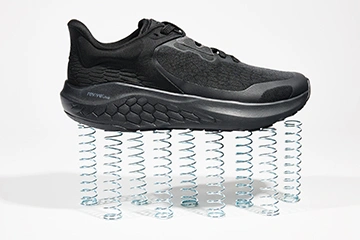
Cushioning shouldn’t just feel soft—it should last.
Shoes For Crews’ REVIVE™ Ultra cushioning is designed to balance comfort and support over long hours, not just at the start of a shift. Instead of relying on a single layer of foam, REVIVE™ Ultra uses a dual-density design: a softer core that cushions impact, surrounded by a firmer frame that helps maintain structure as fatigue builds.
The result is cushioning that feels forgiving underfoot without collapsing over time. As pressure increases and steps add up, that outer support helps keep the shoe stable, so comfort doesn’t disappear when the shift gets hard.
Built using an advanced foam process that creates ultra-fine bubbles throughout the midsole, REVIVE™ Ultra is engineered to absorb impact and return energy step after step on hard hospital floors. There’s no glued seam between layers, which helps the cushioning work as a single system rather than breaking down unevenly.
Anti-fatigue cushioning matters most late in the shift, when every step feels heavier. Cushioning that fails early always shows up late.
For extra cushioning and support, pair a REVIVE™ Ultra shoe with OS1st® performance socks.
2. Stability when the body is tired
As exhaustion sets in, stability becomes critical. When muscles are fresh, the body can correct small imbalances. But when fatigue hits, those corrections fade.
That’s where structure matters. A stable base helps support posture and movement when the body has less left to give—especially during fast pivots, long standing, and repetitive walking. Stability isn’t stiffness. It’s consistent support that holds up as fatigue accumulates.
3. Slip resistance when reaction time is lower
Traction always matters. But it matters most at the end of a shift, not the beginning.
Many slips don’t happen because floors suddenly change—they happen because fatigue slows reaction time.
TRACTIONiQ™ slip-resistant technology is designed to help deliver reliable grip on hospital floors, supporting steady footing when nurses are tired, moving fast, and focused on patient care—not on their next step.
Why women’s-first design makes a difference
Women’s feet are not smaller versions of men’s. Fit, arch shape, heel geometry, and pressure distribution differ—especially during long shifts.
When shoes aren’t designed for women’s anatomy, discomfort shows up sooner and lasts longer.
LILA™ footwear was designed specifically for women working long shifts—balancing comfort, support, safety, and self-expression.
What to look for in true 12-hour shift nursing shoes
If shoes are going to hold up through hour 10 and beyond, they need to deliver consistently.
Look for:
- Cushioning that doesn’t collapse over time, like REVIVE™ Ultra
- Slip-resistant outsole shoes built for healthcare professionals
- A supportive fit designed for women’s feet
- Shoes with easy-to-clean treads that hold up to daily wear
- Construction built for long shifts—not first impressions
Comfort that lasts isn’t accidental. It’s designed at Shoes For Crews.
Explore our recommended nursing shoes, designed for 12-hour shifts and real hospital floors.
You earn your title every shift. Your shoes should earn their place.
Nurses don’t earn their title in a moment. They earn it hour by hour.
Footwear should support the work—not add to the burden. Because comfort isn’t indulgence. It’s safety.
Explore LILA™—shoes designed for 12-hour shift comfort and built for real hospital floors.
Employees and Your Bottom line.
Don't Forget To Share This Post!

4 Safety Risks for Nurses and Nurse’s Aides
Nurses and their aides put themselves at risk every day to properly do their jobs. Learn the top 4 safety tips for nursing in the healthcare industry.

How to Identify and Manage Slip, Trip and Fall Risks for Healthcare Workers
Read this SFC Safety Blog post to learn about common threats healthcare workers face and how to manage risks to reduce workplace accidents and injuries.

What is the Value-Add of a Corporate Safety Footwear Program?
Do you know what value-add meaning is in a corporate safety footwear program? Find out how it can help you reduce your workers’ compensation costs.