
Nathan Crary Joins EnCompass Safety Podcast

In an episode of the EnCompass Safety Podcast, Compass Group Canada’s Vice President of Risk Management, Brian Riley, sat down with Nathan Crary, Chief Supply Chain Officer at Shoes For Crews® (SFC), to unpack the science, strategy, and significance behind slip‑resistant footwear. This conversation not only highlights SFC’s deep expertise in performance footwear but also showcases the strength of a long‑standing, value‑aligned partnership with Compass Group Canada—a relationship built on trust, collaboration, and a shared commitment to safety and operational excellence.
With feet firmly grounded in more than three decades of industry experience—spanning leadership roles with Nike, Deckers, and top global footwear brands—Nathan brought nuanced insight to a topic many professionals take for granted. What might seem like a simple shoe choice in workplaces like kitchens, hospitals, schools, and major venues, is actually a critical piece of safety infrastructure.
Understanding What Makes Slip‑Resistant Shoes Truly “Slip‑Resistant”
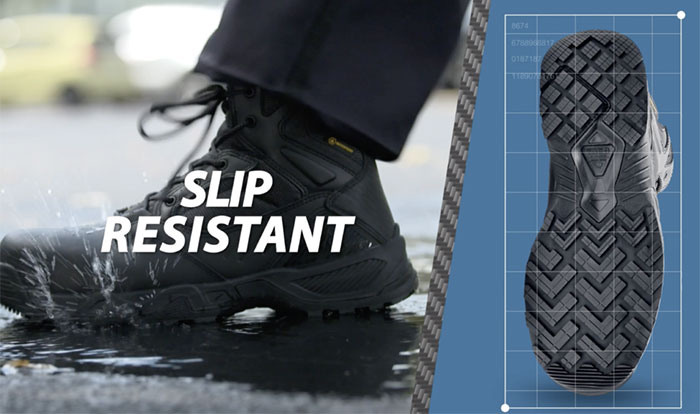
One of the central themes of the discussion was the technical differentiation between everyday footwear and slip‑resistant shoes. What makes a shoe reliably slip-resistant isn’t decorative tread or branding— it’s scientific engineering.
Nathan explained that “there are two major factors that differentiate true slip‑resistant footwear from traditional shoes.” The first is the mold design: unlike conventional outsoles with rounded or inconsistent edges, high‑quality slip‑resistant soles have flat, sharp lug edges that engage surface contaminants more effectively. The second is the rubber compound. Instead of natural rubber, which can absorb oil and lose traction, SFC uses synthetic NBR rubber—a compound widely trusted in automotive applications like gaskets and windshield wipers for consistent performance under oily conditions.
Nathan’s explanation helps demystify what many people assume is a simple product choice—when in fact, it’s the result of years of material science and design refinement.
Rigorous Testing for Real‑World Performance
Nathan also walked listeners through how slip‑resistant footwear is tested and validated. While industry practitioners may be familiar with the Mark II (Brungraber) test—which evaluates rubber slabs in isolation—he emphasized the importance of ASTM F2913 testing.
Unlike basic methods, ASTM F2913 tests a complete shoe under varied conditions, measuring traction at the heel, forefoot, and flat foot across contaminated surfaces. This real‑world approach accounts for outsole geometry, shoe shape, and midsole softness— all critical variables in true performance. Every set of published results SFC shares is conducted by third‑party labs, and internal factory testing continually monitors wear and consistency. As Nathan noted, if slip performance degrades by more than 10%, molds are replaced—a commitment to quality that underpins end‑user reliability.
Practical Value & Safety Outcomes
Beyond the technical depth, Nathan offered practical insight into how slip‑resistant footwear translates into safer workplaces. He referenced a CDC and NIOSH study where a slip‑resistant footwear program led to a significant drop in workplace slip‑and‑fall incidents—underscoring that the value isn’t just theoretical.
A particularly thoughtful point Nathan made was about human behavior: in environments perceived as safe, individuals tend to walk more confidently. But if they aren’t equipped with proper workplace safety footwear, that confidence can increase risk. “Risk exists even when it’s not visible,” he said—a reminder that safety measures must anticipate human behavior, not just environmental hazards.
Maintenance, Longevity, & Worker Comfort
Nathan didn’t shy away from practical operating questions either. For example, maintaining slip resistance isn’t passive—keeping outsoles clean is essential. SFC has redesigned tread channels to be wider and easier to rinse, directly addressing real user needs.
As for replacement, Nathan advised inspecting lug wear visually: if more than half the lug height is worn, it’s time for a new pair. For many workers, rotating between two pairs can extend lifespan and comfort—a simple recommendation that reflects an experienced perspective on day‑to‑day operations.
Read more on how to make work shoes last longer.
Celebrating Partnership & Forward‑Looking Innovation
Nathan also spoke to SFC product extensions like CREWGUARD® overshoes for visitors or temporary needs, and winter‑specific traction solutions like 4SG™ outsole tech developed with Canadian lab partners. These innovations reflect a partnership mindset—understanding that safety solutions must be adaptable, context‑specific, and easy to implement.
Compass Group Canada and Shoes For Crews share more than a vendor‑client dynamic. As Nathan put it, “This is all we do. Every day, our focus is on making footwear as effective, durable, and safe as possible.” That relentless dedication to safety and performance reflects a shared mission—one grounded in trust, real-world insight, and consistent innovation that serves frontline teams across diverse environments.
Final Takeaway
For operations leaders and safety professionals, this episode is more than a technical brief on footwear. It reinforces how thoughtful leadership, real‑world insights, and trusted partnerships create safer, more resilient environments.
To experience the full depth of this conversation and gain additional insights from Nathan Crary, we encourage you to listen to the full episode of the EnCompass Safety Podcast
Employees and Your Bottom line.
Don't Forget To Share This Post!
The Key to Slip-Resistant Safety Shoes
Not all slip-resistant shoes for workers are equal. Find out how genuine slip-resistant footwear carries a high Coefficient of Friction (COF) score.
Workplace Safety 101: Preventing Slips, Trips and Falls
Preventing slips, trips, and falls is Workplace Safety 101 and of the utmost importance. SFC Safety explains how everyone can ensure a safe work environment.

How to Create an Accident Incident Rate Benchmark
How does your company stack up to the national injury incident rate averages? Learn how to calculate accident ratios to benchmark new safety guidelines.